Tattoo Function
SOCIOLOGY
This feature was co-authored with Scott Cosio and Yasmine Delecluse.
Object of study and starting point
We have chosen to take an interest in the culture of tattooing. Forbidden, marginalized, hidden for a long time, it fascinates us. Since the dawn of time, men, grouped together in "societies", have devoted themselves to marking and body decoration (tattooing, piercing, scarifications, etc.). An incomprehensible gesture for some, an art in its own right for others, tattooing is now present everywhere, all social classes combined, on individuals of all ages.
The tattoo fascinates but is also pointed out as something "Evil": what justifies this duality? How then to explain this Western appropriation of this practice, which not so long ago, was "Objectionable" (and still is in some parts of the world)?
Why deal with this theme?
It is with certainty that we know that the earliest known tattoo is 5300 years old. Ötzi the Ice Man, nicknamed after being in a glacier in the Italian-Austrian Alps, wore 61 tattoos of parallel lines along his spine, as well as crosses and dashes on his joints. The tree designs were very simple unlike other more recent finds. It is established that tattooing is an ancient practice, which for centuries has developed independently in different parts of the world.
Over the centuries, however, tattooing has grown in popularity and is now a fashion.
How is it that this practice, originally specific to certain minority populations, has taken on such a scale today? What justifies the Western appropriation of tattoo culture?
A skin relationship to the world
Identity matter at the individual and collective level, the body is the space that is given to see and read, David Le Breton
Our condition as a man is bodily. It is through our senses, hearing, sight, smell, touch, that we interact with the world around us. Our skin is this surface - full of sensors - that envelops us, this ultimate border between the individual and the others, me and the rest of the world. This is the symbolic limit between the inside and the outside.
Beyond its protective biological function, it is through the skin that we are recognized and identified: its color will indicate which ethnicity the individual comes from, its radiance will give clues to a social condition...
We only have one skin: although this has a great capacity for regeneration, it bears, like archives, the marks of our history. The scars, burns, marks, stains that cover it are just as many clues that can be read to the outside world. The skin trace then turns into a sign of identity, suffered or chosen as is the case with tattooing. In fact, for a long time, skin marks were used to identify the bodies of men who fell on the battlefield.
As soon as an individual chooses to mark his skin, the latter becomes an instance of self-fabrication: we stage his appearance, we deliberately modify the representation that others have of us. We adapt it to look what we want it to be. Body markings such as tattoos are identity stoppers in the sense that the individual who uses them uses their skin as a screen that projects the world a dream identity, a self-improvement. He reappropriates his body in this way and distinguishes himself from his peers by the marks of his skin.
As old as humanity, body marks have long been considered by Westerners to be "barbaric" and "savagery" acts since originally it was so-called "primitive" peoples who engaged in them. Once confined to marginality, tattooing in particular, is now part of a consumerist beautification process. Today it is not uncommon to find tattooed people who mix on their skin various types of tattoos with multiple origins, of which they ignore the original meaning, but who did it "because it is beautiful" or " that it looks good ”.
The craze for tattoos today accompanies the liberation movement of individuals: the skin is more than ever an instance of making presence in the world. In a society of appearance and necessity of appearance, the search for differentiation can lead some individuals to extreme practices. Universal and ancestral practice, tattooing is part of the customs of many peoples. The oldest traces would have been found on a man who died more than 5000 years ago “Otzi”. He sported small parallel lines, probably for their virtues considered as therapeutic. A rite of initiation, a sign of identity or a protective mark among the Celts, the Japanese, the Egyptians and the Polynesians, tattooing had almost ended up disappearing from tribal traditions over the centuries. But in the 18th century, it returned to the skin of sailors, inspired by Tahitian customs discovered in the Pacific by James Cook.
The multiple origins of tattooing
Body marking practices, depending on the region of the world in which they are studied, can have very different meanings. Indelible or temporary, bodily signs are likely to take on many meanings, sometimes simultaneously: sexualization, access to social maturity after rites of passage, beauty, decoration, eroticism, fertility, personal value, hierarchy, protection, divination, propitiation, mourning , stigma...
Addressing all the meanings and origins of the tattoo would be a very tedious and long task and this file would then take a whole different turn. This is the reason why we have chosen to address a few which are the notion of tribalism, rituals and rites of passage and the function of identification.
1. Tribal
Historically, a tribe consists of a social formation that existed before the formation of the state. Some people use this term to refer to people with non-Western lifestyles or indigenous societies. Certain ethnologists use this word to designate societies organized on the basis of kinship ties, especially families with the same descent. In some countries like the United States, or India, tribes are indigenous peoples who have legal recognition. Tribal governments can be a tribal chief or some sort of tribal council, which represents the tribe and is usually made up of old and wise people. In Canada, the term "nation" is preferred to "tribe".
Origins
The tribal tattoo is inspired by ancient traditions of different cultures and peoples. Now a popular body decoration, the tribal tattoo is characterized by symbols that have their own meaning. Cultures from which tribal tattoo ideas are often borrowed are those of Borneo and the region of Polynesia, the Aztecs and India. In recent years, Maori and Hawaiian tattoos are also very successful.

Tattoo combs
Polynesian tattoos (Tatau)
Tattooing has developed the most in Polynesia (Marquesas Islands and New Zealand). It generally marked membership of a high social rank. Among the Areois, society is divided into classes highlighted by the arrangement of tattoos on the body. Each class taking the name of tattooed parts. Thus, the first class, the highest, is called “tattooed legs”, the second “tattooed arms”, the third “tattooed sides”…
The practice of tattooing in these cultures was aimed at strengthening fertility and links with the supernatural and the sacred. In Polynesia, the baptism of the child is tattooing. To be registered in the community, the Polynesian must go through rites imposed by the tribe. It is then a family and religious ceremony.
Marquesan tattoos (Te Patutiki)
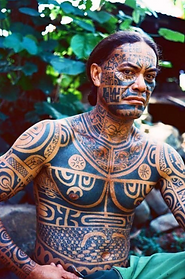
The tattoos done there are mostly aesthetic. All parts of the body are tattooed, with the exception of the palms of the hands and the soles of the feet. The more numerous, rich and varied the designs, the older and higher the person is in the social environment.
At the end of the 19th century, a person without the back of their hand tattooed could not help themselves from the communal pot. Likewise, a man could not ask for a young girl's hand if he had not been tattooed beforehand. It is for this reason that the tattoo was done from puberty.
During the tattooing ceremony, women were not allowed. The tattoo was performed by a priest under the chants of the spectators serving to encourage future tattooed people to endure the pain. The newly tattooed youth did not come out until after the final healing. Regarding the face, the chiefs could cover it completely while the other members left traces only on certain areas of their body. A beautiful tattoo for the Marquesan is therefore a mark of pride and pride, as it requires many sessions and moreover is very painful.
The instrument used for tattooing was a wooden handle (often bamboo) on which we fixed the most diverse objects such as a bird's bone, a piece of mother-of-pearl, fish teeth… The tattoo artist tapped on this tool using a small hammer to facilitate penetration into the skin. The ink was made from carbon black taken from the Bancoulier nut (a tree that grows in the Pacific Islands), then mixed with water.
New Zealand (Maori) tattoos
The tattoo in New Zealand is inseparable from marriage: for the young girl, the tattoo of the face is an element of embellishment. For men, tattoos are an element of seduction, a marker of virility and strength.
The Maori uses a sharp element (knife, chisel…) and not a needle to tattoo. The tattoo is done in his twenties and anyone who refuses to submit is seen as effeminate, lacking courage and unworthy of being part of the community.
Maori are also famous for their tattoos covering the face called “Moko”. As the traffic in tattooed heads developed strongly in the 14th century, wearing a "Moko" also ran the risk of being beheaded. The “Moko” is a mark of nobility, it claims for the one who wears it an accomplished victory. Among Maori women, the tattoo also had an erotic power, depending on the local culture.

2. Rituals
Rites (or rituals) are a set of prescribed rules that structure the relationships between individuals of the same community. These are communicative strategies that frame the social actions and the conversations that animate them. It can also be a formal and conventional act by which an individual shows respect and consideration towards an object of absolute value, to that object or to its representative.
The realization of the tattoo, by the pain that this generates, constitutes in itself a rite of passage to a higher social level. Initially, body marks were signs of belonging to a social group, be it tribe, religious belief, pirate, former prisoners or former legionaries.These marks are a kind of history on their skin and cannot be erased.
Rite of passage: adulthood in Polynesia
In Polynesian societies, the practice of tattooing was an operation that put a strain on the body. Painful, it had to be supported by the young people. A set of rituals and tapu (something forbidden related to the sacred, antonym for permit) was performed. As soon as an individual was tattooed, if he then came into possession of a second skin, supposed to protect him, then serving as a shield
One of the main functions of the tattoo was to mark the beginning of adulthood, in order to mark a break with the Po (the realm of darkness). These tattoos symbolized strength, power and wealth.
For young girls, it was important to have all the pre-defined ritual tattoos when they reached marriage age. The tattoo was here used to mark the different stages, the different accomplishments of the girls. That's why they started getting tattoos very early on. The first marks were tattooed on the elbow. Thanks to these, they were freed from the tapu relating to food described above. They also had to have their hands tattooed afterwards in order to prepare the family meal.
They were then tattooed a second time when they hit puberty. And it was then that large black spots covered their buttocks with outlines in the shape of arches. They were tattooed like this to indicate that they could be considered sexually mature and ready for marriage. Often, high-ranking women also had their entire lower abdomen tattooed. These brands were then supposed to promote their fertility.
For men, tattooing was seen as a difficult duty. Indeed, was described as brave the one who endured the operation without cries of pain. It seemed complex to escape this practice. Despite being painful, it was a way to make the body less clumpy and more attractive to celebrate coming of age, since tattooing was traditionally done from puberty. That’s why, anyone who didn’t have tattoos ran the risk of getting blamed and openly insulted.

Rite of passage: Mentawai tribe
The Mentawai or “flower men” are an indigenous population of the eponymous islands off Sumatra in Indonesia. These people are "animists", which means that they consider that every object is animated by a soul. They live in harmony with the forest which provides them with food.

For the Mentawai, tattooing is an important custom and they are probably the first people on Earth to have practiced it.
The tattoo fulfills 3 different, complementary and essential functions in their social structure.
It is at first a religious ritual. Through animist rituals, the tattoo helps to preserve the soul by preventing the latter from leaving their body. The tattoo is a kind of key which encloses the soul in the body of the individual. Added to this, Mentawai people wear jewelry and flowers to feel “beautiful” but also to make the soul want to stay in their body.
The second role is social: it determines the place and role of the individual in the tribe. It therefore marks membership of a clan or a family by the motif of a particular symbol. Finally, it is like clothing and protects the individual. According to their beliefs, the tattoo can be a substitute for clothing.
These ancestral tattoos cover the body almost entirely. The original meaning has faded from their memory due to an attempt at "civilization" on the part of Catholic missionaries. Today, they wear these tattoos to reclaim their culture and identity, they also act as codes of recognition for themselves and their ancestors. The tattoo therefore becomes the link between the present (the living) and the future (the ancestors) that they will find after their death in the “Hereafter”.
3. Identification
Throughout history, the tattoo has been stigmatized because of the origin of those who wore it, the marginalized, the isolated ... Yet social groups have reversed the movement to make tattooing a way of getting started. the gap. With prisoners and criminals it happens that individuals take up an element that stigmatizes them in order to decide for themselves on their exclusion. Thus, in some groups, tattooing and other body markings are used in order not only to step aside but to provoke others through the visual they render on the street or in public spaces.
Tattoos as a sign of belonging to Japan Examples of meanings of tattoos in the Edo era (1600-1868) in Japan. At that time, a codification of the tattoo called “Kojiki” was introduced and makes it possible to distinguish the prestigious tattoo, reserved for heroes and the great and the villainous tattoo, reserved for bandits and criminals. According to the police, the tattoo was a kind of punishment in order to deter potential crimes.
- The “Yujo” (prostitutes) of the pleasure districts, used tattoos to increase their appeal to customers.
- The firefighter tattoo is a means of spiritual protection. The
- “Hikyaku” (couriers and laborers) often worked unclothed, so as not to feel embarrassed they covered their bodies with tattoos.

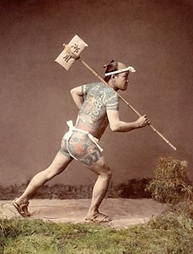
Yujo (left) and Hikyaku (right)
The Yakuza
The Yakuza are an organized crime group in Japan and are represented by 4 main unions, present all over the archipelago, and also have ramifications in the Pacific area and even in Germany and the United States.
The tattoo is there a test of courage and endurance because to be tattooed is a painful and very long experience which is practiced in a traditional way. There is no electrical equipment used but only bundles of needles attached to a bamboo or steel handle.
The Irezumi, which means tattoo in Japanese, covers a large part of the person's body. It can be the arm, the leg, the back, or the whole upper body and can even extend from the neck to the feet.
Some tattoos have specific meanings and identify the actions of people during their lifetime. For example, there was a time in Japan when every circle tattooed around the arm represented a committed crime. Today that has changed. Yakuza members are mostly tattooed to honor their "family".
In Japan, tattooing remains a taboo subject and a symbol with a negative connotation. It is strictly forbidden to go to public baths if a person has a tattoo or even to invest in finance. However, the Japanese love shadows. Seeing a tattoo that cannot be seen when there is light makes the tattoo even more beautiful.
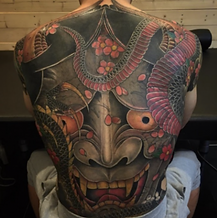
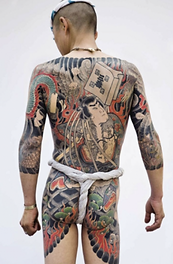
Epistemological analysis
Rebel and provocative body
The Spanish and Portuguese settlers, when confronted with the so-called primitive populations and their skin adornments, were horrified by what they have long considered to be abominations. Body marks are therefore irreducible "savagery".
It is the marginalized Western populations who will be the first to seize it. Sailors and prostitutes will be the first to indulge in this "eccentric" practice. These changes will then be paid into the account of lasciviousness and savagery.
These populations, already rejected for the extra-ordinary ways of life, make the deliberate choice to differentiate themselves even more, as a way of definitively rejecting a “traditional” way of life, of claiming their moral unworthiness and of assuming their responsibility. eccentricity. Their skin becomes the projection surface whose alteration, unnatural, testifies to the refusal to be like others.
The culture of tattooing in our societies, and which remained dominant until the early sixties, is part of a popular, masculine, heterosexual culture aimed at asserting virility, strength of character, aggressiveness ... It is given in opposition to bourgeois culture. However, tattooing will attract men and women from privileged social backgrounds who, through tattooing, want to display their independence of mind.
Ritual pain
The tattoo, because of the pain it causes during marking, has long been invested in a high place of virility. Whoever wears a tattoo has resisted the pain of the needle to obtain the artwork that will mark their skin forever. So, for many, the pain is sublimated by the process it accompanies, the metamorphosis it announces, the satisfaction of accomplishing something that has been long awaited. Pain contributes to the "spiritual" and "initiatory" dimension of the act. Once tattooed, you are not the same person anymore. If pain is felt, it is necessary, it is a necessary step with a moral dimension that changes its meaning and erodes its painfulness.
Autonomy and self-signature
For the younger generations, body marking is experienced as a distancing, an empowerment with regard to parents and the authority they may have exercised. It is all the more invested when parents oppose it. This deliberately provocative act is also a way for the young person to assert himself as an "I", to separate bodily in the family cocoon and to appropriate his body. The tattoo then becomes individualizing, a way of signing oneself as different from others. For the youngest, it is often a spontaneous, thoughtless gesture, a rebellion that gives the feeling of existing, of shaping oneself as one would like to be, reaching a dreamed ideal. Also, in that it sports an emblem of itself enhances the feeling of identity and finally provides a feeling of existing in the eyes of others through the over-valuation of which it will be the object.
Tribal nostalgia
The cultural wave of body markings is one of those contemporary forms of "'inventing tradition'. She creates something new against a background of the old, the meaning of which is forgotten or ignored. She reformulates the signs: it is a giant toolbox in which everyone comes to tinker with meaning for their own use. (ex: Khmer tattoos).
In our contemporary world, signs float and lose their roots. their meaning then depends solely on whoever appropriates them. (ex: Japanese tattoos, ..).
One of the primary sources of body markings comes from an idealization of traditional societies. We imagine a folklore around these traditional societies, we build a whole story from a few snippets heard right to left.
Emptied of its primary meanings, the tattoo becomes an element of originality, a vague spiritual reference, which each person stages by tinkering with their own meaning. Tattoos are presented as a paradoxical aesthetic in individuals who appropriate them regardless of their origin...
"The culture of the Other, transformed into available raw material, aestheticized in style after having disappeared from real existences, then becomes the pretext for Western cultural practices which are far removed from it? "
We can compare this use of signs outside of the conditions that give it its full meaning to a quotation: it is not the entire original text, only an excerpt, which is interpreted and sometimes distorted. The tattooed person invents a myth of their own around their tattoo and the signs that it has appropriated it.
Contemporary significance
Tattoos, although they no longer have the same meanings, are renewing the uses of traditional societies in our societies.
The tattoo is an attempt to differentiate oneself, to establish a border between oneself and others, while leaving bridges so as not to get lost in loneliness. Many tattooed people mix a discourse of singularity and the feeling of participating in an undercurrent of society. In a society where disinvestment from social systems is omnipresent, withdrawal into the body, appearance and affects is the means to reduce uncertainty by seeking to exist.
In a society of looks and images, you have to make yourself an image in order to fully exist in the eyes of others. Being oneself is no longer a simple matter of course, but a job that requires owning certain accessories: individuation is no longer done by a personal journey but goes through a sign, a bodily mark unearthed in the toolbox or these. proliferate. Body marks differentiate while translating a filiation to a floating community (techno, punk, tribal, gothic, gang, etc.).
Here we find a consumerist logic: to be compliant while having the gratifying feeling of being completely unique.